
So you have been posting on YouTube and your views are climbing. Now you think like every creator that how can I turn this into money? If you want to learn how to monetize your YouTube channel:
- You need to create original and advertiser friendly content.
- Meet eligibility criteria for YPP (YouTube Partner Program).
- Apply through YouTube Studio, link to your AdSense account.
- Turn on your specific monetization features you qualify for.
Ad revenue is just one piece of puzzle, there are more ways to earn money from your YouTube channel, from Super Thanks to sponsorships to selling your own products. YouTube also changed its Partner Program structure this year, dividing eligibility into two tiers instead of one flat bar, and it is already confirmed that further changes are coming in 2027. If you have read an older “how to monetize your YouTube channel” article, some of what it tells you is old update. This guide walks you through the current rules, the watch-hour and Shorts requirements, what the Partner Program actually gives you, and honestly, what you can expect to earn per 1,000 views without the inflated numbers lot of blogs like to throw around.
| TL;DR: How to Monetize Your YouTube Channel? 1. Make original content that follows YouTube’s monetization policies. 2. Hit the subscriber and watch-hour thresholds for the YouTube Partner Program. 3. Apply for YPP through YouTube Studio’s Earn tab. 4. Link an active Google AdSense account. 5. Get approved then switch on the monetization features you are eligible for. 6. Make additional income outside YouTube’s own program such as sponsorships, affiliate links, your own products or services |
Everything below we explain in detail, plus numbers that you need to hit for monetization.
What is the YouTube Partner Program?
The YouTube Partner Program is YouTube’s official program, run directly by YouTube, for creators who want to earn money through YouTube monetization features. YouTube evaluates potential review channels and continues to do the monitoring after they join. So the procedure of monetization is anything other than a one-time confirmation without focusing on subscriptions and views.
According to YouTube’s official policies, content that brings monetization should be original and authentic. If the content is repetitive or lacks originality, it is likely to be considered inappropriate for monetization.
How To Apply For YouTube Monetization?
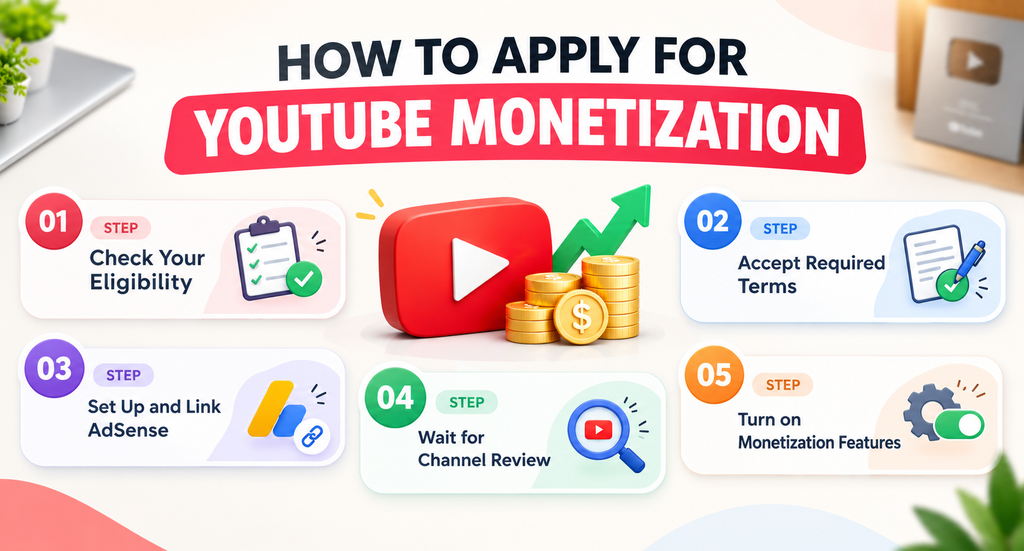
If you are particularly searching for how to monetize your YouTube channel, then first follow this process:
Step 1: Check Your Eligibility
- Open your YouTube Studio and go to Earn section.
- YouTube will show your subscribers, watch hours or Shorts views, and any outstanding policy issues. This is the only place to check your real status.
Step 2: Accept Required Terms
To proceed, you will have to read and accept the YouTube Partner Program agreement. This is not just a formality but represents the core principles that regulate revenue sharing, ownership of content and enforcement of policies of any kind while you are in the program.
Step 3: Set Up and Link AdSense
YouTube payments depend on AdSense. YouTube users with an acceptable AdSense connection should consult YouTube’s instructions for establishing it. Users without an AdSense connection should create one at YouTube Studio.
Step 4: Wait for Channel Review
As stated in YouTube’s Help Center, reviews may take as long as a month, though most receive feedback sooner. Subscribers and watch hours are the minimum requirements for consideration, but getting past this first step does not guarantee approval. Your videos will be reviewed for originality and suitability for advertisers. Standard causes for rejection include reused content, compilations that provide no added value, or existing Community Guidelines violations.
Step 5: Turn On Available Monetization Features
Once approved, look over the Earn tab once again. Activate the features that can help you monetize your content according to the type of audience you have. Certain features may be unavailable based on the geographical area from which you are operating, the type of content you create, and your channel status and eligibility.
How Does YouTube Monetization Work?
YouTube monetization means earning money from YouTube content that you publish on YouTube. YouTube monetization covers two different things:
First is YouTube Partner Program (YPP). YPP gives eligible creators access to built in YouTube monetization features. Depending on your eligibility, these monetization features include advertising revenue, YouTube Premium revenue, channel memberships, Super Chat, Super Stickers, Super Thanks and Shopping.
Second is everything outside YPP. That means you earn from brand sponsorships, affiliate marketing, selling your own courses, or offering any service to your audience you have built. None of this needs YouTube’s approval at all. YouTube channel with 3,000 subscribers and no ad revenue can still make solid money from single sponsorship deal.
You need to understand that getting more views does not mean you will get high paycheck from YouTube. YouTube pays out based on ad impressions actually served against your videos not raw view count, and huge chunk of your views may never generate ad revenue at all, more on that later in the earnings section.
YouTube Partner Program vs. Other Ways to Make Money from YouTube
| Method | YPP Required? | Example |
| Ad revenue | yes | When ads are shown on eligible videos |
| Shorts revenue | yes | Revenue from ads shown between shorts |
| YouTube premium | yes | Share of premium subscription revenue |
| Channel memberships | Eligibility required | Monthly payments from members |
| Super chat and Super stickers | Eligibility required | Viewer payments during live streams |
| Super thanks | Eligibility required | One time viewer payments |
| YouTube shopping | Eligibility required | Product sales |
| Sponsorships | no | Brand pays for sponsored video |
| Affiliate marketing | no | Commission from sales |
| Own product/services | no | Any of your own services you offer |
Now see the difference, ‘get monetized’ and ‘make money from YouTube’ are not same thing.
YouTube Monetization Requirements in 2026?
This is the section that most creators are searching for, so let’s understand YouTube monetization requirements.
Standard YouTube Partner Program Eligibility
To get full YouTube monetization (meaning ad revenue and YouTube Premium revenue sharing) you need to fulfill one of these conditions:
| Condition 1 | Condition 2 |
| 1,000 subscribers and 4,000 valid public watch hours in the past 12 months | 1,000 subscribers and 10 million valid public Shorts views in the past 90 days |
Along with this, YouTube also verifies that you follow its monetization policies, live in a country or region where YPP is available, have no active Community Guidelines strikes, have 2-Step Verification turned on, and have a linked, active AdSense account.
Expanded YouTube Partner Program Eligibility
YouTube also offers YPP for eligible creators. The eligibility criteria are
- 500 subscribers
- At least 3 public uploads in the last 90 days
- Either:
- 3,000 qualified public watch hours from long-form videos in the last 365 days, or
- 3 million qualified public Shorts views in the last 90 days
This level can provide access to features such as
- Channel memberships
- Super Chat
- Super Stickers
- Super Thanks
- Shopping
It is important not to confuse this threshold with the requirement for full advertising revenue.
Your YouTube channel can qualify for earlier YPP features without yet qualifying for Watch Page or Shorts Feed ad revenue.
YouTube Watch Hours: What Counts?
One of the most common questions asked by every content creator on YouTube monetization is how YouTube watch hours are calculated. Watch hours are total time viewers spend watching your public, long-form videos during the previous 365 days. A few things to keep in mind:
- Only public videos count, private or unlisted uploads don’t contribute
- The 12-month window is rolling, so old watch time can drop off if you go quiet for a while
- Shorts views and long-form watch hours are tracked and counted separately
- If you unpublish or delete video, its watch hours come off your total immediately
That last point often catches people out more than anything else. If your dashboard indicates that nearly 4,000 hours have remained and you’ve cleaned up your channel by removing the old videos, you can watch it drop overnight.
Shorts Views vs. Watch Hours
Short creators have separate route into YPP.
| Route | Subscribers Needed | Performance Requirement |
| Long form | 1000 | 4,000 valid public watch hours in 12 months |
| Shorts | 1000 | 10 million valid public Shorts views 90 days |
Additionally, there is the YPP lower entry threshold of at least 500 subscribers in addition to either the required 3000 public watch hours or 3 million public views on content. This allows creators to pursue two different paths to achieve monetization.
For example, those who make tutorial and review videos or lengthy entertaining videos may find the watch hours route more suitable than the one based on views of short videos.
Also Read: Best Free SEO Tools for YouTube to Grow Your Channel
8 Ways to Monetize Your YouTube Channel
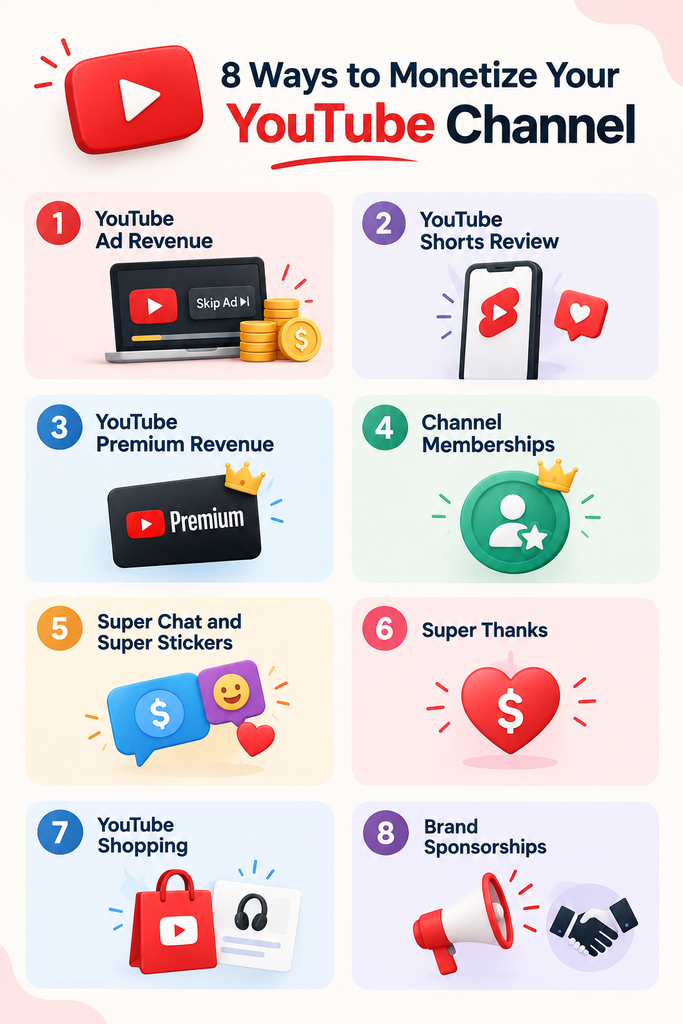
Joining YPP is important step but this is not only way to make money on YouTube. Here are 8 main YouTube monetization methods:
1. YouTube Ad Revenue
Advertising is one of the main sources of revenue for creators on YouTube. Eligible creators earn from advertisements displayed in their videos. Currently, for long-form videos, YouTube claims that creators earn 55% of the net revenue generated from ads shown on public videos in the Watch Module. However, not every view will generate an ad.
Thus, therefore, a user might not see an ad, or the video may be eligible for limited advertising opportunities, which is one of the reasons why you cannot simply calculate revenue based on a fixed rate and the total views.
2. YouTube Shorts Review
Short videos work under different revenue-sharing schemes. In the Shorts Feed, advertisements are shown between clips. YouTube collects relevant ad revenue, determining revenue shares based on the Shorts monetization rules.
According to the latest information from YouTube, content creators get 45% of the revenue allocated to them through the Shorts Creator Pool. So, the revenue for Shorts is different from that of typical long-form videos.
3. YouTube Premium Revenue
Those who have subscribed to YouTube Premium are exempt from watching the regular ads that show up on the platform. Those who create content on the platform still get a share in the earnings from Premium subscribers when they watch their video.
As a consequence, channels that monetize their videos generate revenue from some viewers even in the absence of ads.
4. Channel Memberships
A channel membership allows users to pay on a recurring monthly basis in exchange for certain benefits offered by the content creator.
These benefits can include:
- Videos exclusive to members
- Personal badges
- Exclusive posts
- Live streams exclusive to members
- Early access to specific content
Channel memberships work best when you have an audience that is already familiar with your content and is willing to pay for added benefits and privileges.
5. Super Chat and Super Stickers
These elements are beneficial, especially for those who create live streaming content.
Super Chat is a feature that lets viewers’ messages stand out in live chat. Super Stickers let viewers use images in the live chat room.
For those who regularly conduct a Q&A session, gaming streaming sessions, educational sessions, or community discussions, these features may help you create an additional income stream.
6. Super Thanks
Super Thanks gives users the opportunity to pay for relevant lengthy videos and Shorts one time. The viewer gets an animation and has a possibility to leave a comment with adjustments. YouTube informs that creators get 70% of the total earnings produced by Super Thanks except for taxes and commissions.
This feature is especially helpful for small channels because there are many alternative ways to make money with it.
7. YouTube Shopping
Eligible content creators can use YouTube Shopping to display their own merchandise or to go for merchandise of other companies through the YouTube Shopping features that are supported by the platform.
For example, beauty content creators can tag items that are featured in their tutorials, and tech content creators can showcase products appearing in their reviews. Through this, content can be directly linked to purchasing behavior.
8. Brand Sponsorships
Brand sponsorships operate in a distinct manner than YouTube’s native monetization system. A brand might choose to sponsor you by paying you to include its product or service in a video or by paying you to create a special, dedicated sponsored video and/or integrate the product in an existing video.
The good news is that you don’t necessarily need to be fully monetized under YouTube Partner Program in order to work with brands. All you have to do, however, is comply with all relevant advertising and disclosure regulations and inform your audience about any sponsorship deal.
How Much Does YouTube Pay for 1,000 Views in India?
There is no single fixed answer on YouTube for paying 1000 views. YouTube earnings depend on several factors and amount shown in YouTube Analytics varies from video to video.
YouTube compensates content creators in India at a rate of between ₹10 and ₹400 for every 1,000 views, which depends on the content category. Content creators in finance and investment earn ₹150-₹400 per 1,000 views while those in technology and education get between ₹80 and ₹200. Others in business, lifestyle, and vlogging earn ₹70-₹180, ₹30-₹90 and less than others.
CPM and RPM are two terms that you need to know.
Normally, CPM is the amount paid by the advertisers for 1,000 impressions on the ad(s)/the monetized opportunities, depending on the metric that you are using.
RPM, short form of revenue per mille, is the metric that becomes helpful when you want to understand how much creators earn, as it reflects the revenue made for every 1,000 views after the revenue share from YouTube and for the views relevant to the metric.
Consequently, the RPM can be very different in comparison to the CPM.
Also Read: How to Get 1K Subscribers on YouTube organically in 2026?
Common Mistakes That Delay/Block Your Monetization
Many creators only focus on getting more subscribers and watch hours but they overlook YouTube content policies. Here are some common problems to avoid:
- Reused and Duplicate Content: YouTube reused Content Policy affects your YouTube monetization. That means repurposing content from other sources without originality can flag your channel during review.
- Inconsistent Watch Hour Tracking: Sometimes creators do not realize that deleting old videos removes their watch hours from your rolling total.
- Ignoring Community Guidelines: Your channel can also lose monetization access if you violate YouTube relevant policies such as copyright policies, Terms of Service and other applicable policies. Because YouTube monetization policies work alongside its community guidelines.
- Linking Adsense Incorrectly: Follow YouTube’s official AdSense for YouTube instructions and avoid creating duplicate accounts unnecessarily.
- Applying Too Early: Only getting subscriber count is not enough. You need to verify all the criteria before submission, including the necessary watch-hours or Shorts-views standard, the public upload requirement when applicable, compliance with regulations, and the configuration of your account.
What’s Changing in 2027?
If you are planning to make YouTube channel in late 2026, there is one important future update to know about. YouTube has announced changes in YPP thresholds for new creators starting on February 1, 2027. According to current announcement by YouTube, new creators looking to earn money from advertisements must have either 1,000 followers and 8,000 watch hours in the last year or 20 million views on Shorts in the last 90 days.
The prior requirement for fan funding and the related features remains unchanged, as the total number of subscribers must reach 500 together with 3,000 watch hours or 3 million Shorts views.
Wrapping Up
Through learning how to monetize your YouTube channel, you will know how attaining the YPP threshold differs from earning money from your channel.
The year 2026 brings YPP requirements with less stringent eligibility criteria, as well as some limited functionality, while full monetization through YouTube ads requires having at least 1,000 subscribers along with either watch hours threshold or Shorts views threshold.
After being accepted into the YPP program, the monetization opportunities include: good old ads, YouTube Premium, memberships, and Supers and Shopping.
The key moment in the YouTube channel monetization process is creating unique content that is worth watching not just once, but repeatedly. It is important to check the updated requirements by YouTube, as their policies and thresholds might change anytime.
If you need assistance with a content strategy, YouTube SEO, website content, or digital marketing, feel free to get in touch with Edible WebTech for an impactful content plan following your target audience.
Hope this article on how to monetize your YouTube channel helps you to earn money from YouTube.
