
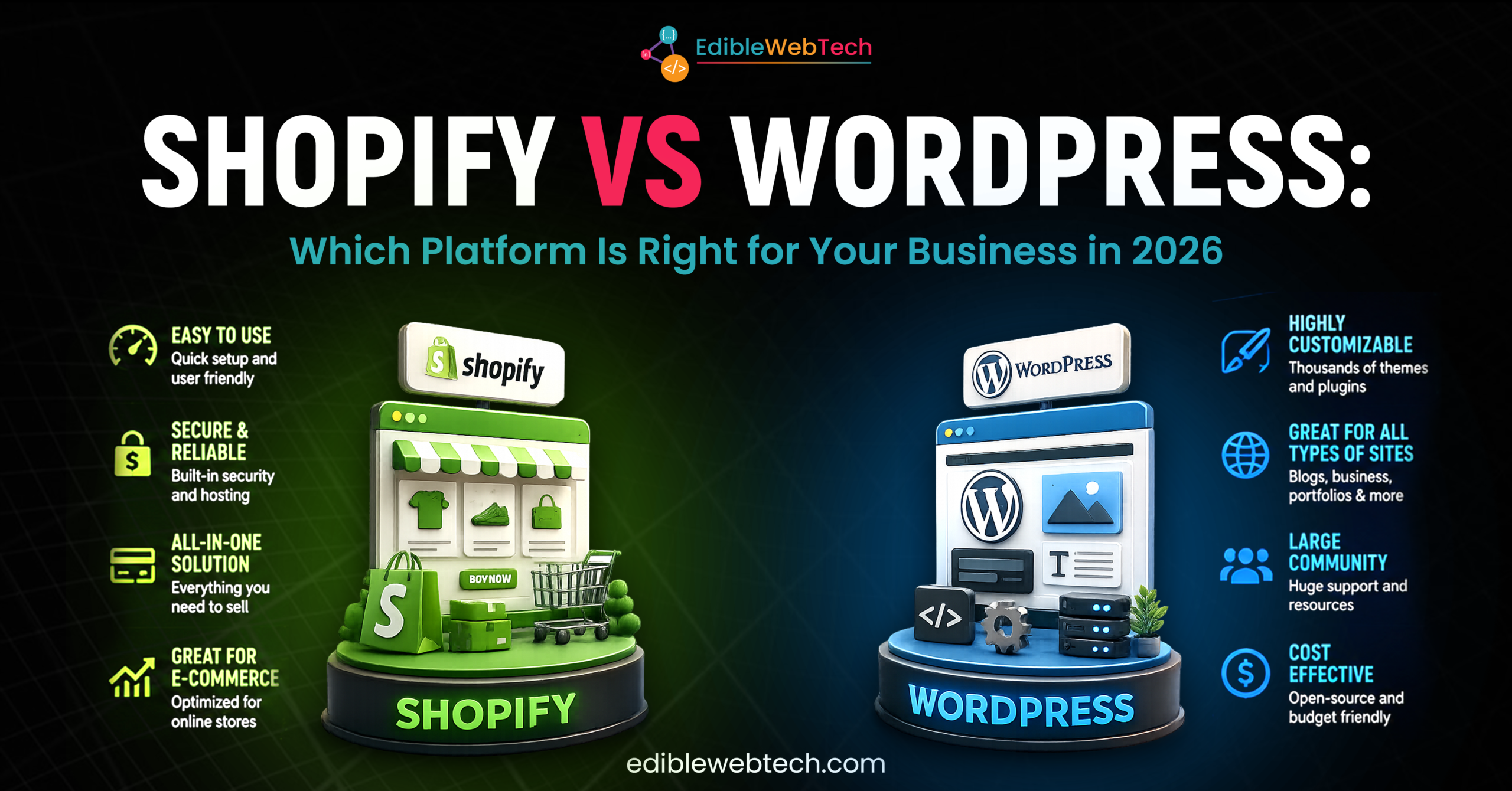
Choosing between Shopify vs WordPress depends on how you plan to grow your business. If you want to start selling fast without the headache of website hosting and maintenance, Shopify is good choice. WordPress with WooCommerce is for businesses who want complete control over design, content, SEO and scalability in long run. Both platforms are good options to create successful e-commerce websites by offering different business goals.
This article shows the real difference between WordPress and Shopify on the basis of cost, ease of use, SEO, design, security, scalability, and AI features so you can match the platform to where your business actually is right now.
| Quick Answer on Shopify vs WordPress? 1. If you are looking to launch your ecommerce website without worrying about hosting and maintenance issues and like to devote all your attention to selling products through advertisers and social media platforms, you should use Shopify. 2. If your priority is to create long-term organic traffic, constantly publish blogs, and have maximum design freedom and implementation capability, WordPress is the right option for you. 3. Want lower budget long term? If you can manage hosting and planning, then WordPress with WooCommerce is a cheaper option. 4. Want low maintenance? Shopify can manage hosting, security, and platform updates for you. |
What is Shopify?
Shopify is completely hosted e-commerce platform that allows businesses to manage and grow online stores without managing technical infrastructure. Shopify was founded in 2006, now millions of online stores are active according to Shopify’s own merchant data. It includes hosting, SSL security, payment processing, inventory management, and extensive app marketplace in single subscription.
Shopify is designed for people who want to sell products without hiring developer or learning to manage server.
What is WordPress?
WordPress is most popular content management system. This CMS platform is for building creating websites and blogs. By utilizing the WooCommerce plugin, e-commerce services have been integrated. WordPress is self-hosted platform, which gives businesses control over their websites.
Based on statistics from W3Techs, the platform has over 43% share of the entire web when it comes to websites using this CMS. It is flexible and allows unlimited customization having countless themes and plugins, and possessing one of the best ecosystems for content creation.
For companies who want complete control over their website and want to grow with organic search, content marketing, and custom functionality then WordPress is perfect option for them.
Comparison Table on Shopify vs WordPress
| Factor | Shopify | WordPress+WooCommerce |
| Hosting | Shopify provides hosting service included in plan. | You need to choose and pay for it separately. |
| Setup Time | It sets up ecommerce store same day | It takes 1 to 3 days for self-hosted store |
| Pricing | Basic plan ₹1,499 per month | WooCommerce main plugin is free but you need to pay for hosting which costs starting from ₹2000 per year, depending on your hosting plan. |
| Coding Needed | No. In Shopify coding skills are not required. | It is not required, but if you have knowledge, it will be helpful. |
| Best for | Product first stores. | Content first businesses and stores. |
| Security and updates | Managed by Shopify | You have to manage yourself |
| Scalability | Easy until you need heavy customization | You need developer time. |
What Is Real Difference Between WordPress and Shopify?
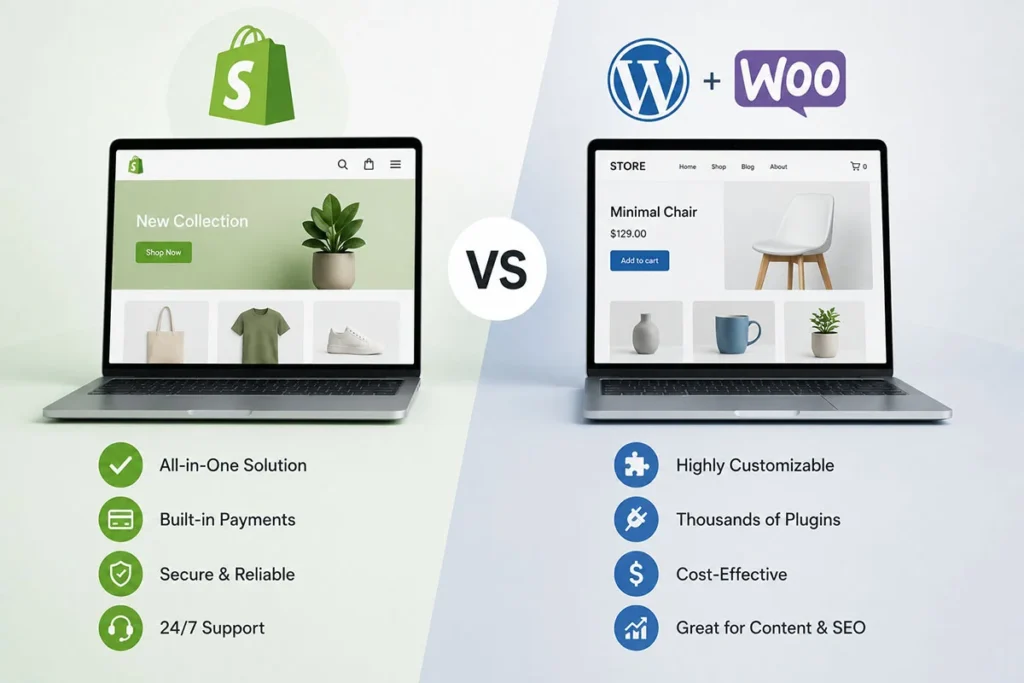
WordPress and Shopify are both popular e-commerce platforms. But both serve different business goals. Let’s compare WordPress and Shopify to see where each platform actually wins.
Shopify vs WordPress: Compare on Cost
When we compare WordPress and Shopify, it is important to consider more than the monthly subscription. Shopify provides predictable pricing structure. WordPress offers flexible pricing but you need to manage other individual expenses such as hosting, domain name, and premium themes.
Shopify follows subscription based model that includes web hosting, SSL certificates, security, software updates, and customer support. That’s why deciding on budget in Shopify is easy because most essential services are bundled into one monthly plan. Businesses may still incur additional costs for premium themes, paid apps, custom development, and transaction fees if they do not use Shopify Payments.
WordPress is free platform. If you need to create e-commerce website through WooCommerce, it requires additional cost. You need:
- Domain name
- Web hosting
- SSL certificate
- Premium plugins
- Premium website theme
Businesses that require custom functionality may also invest in WordPress development services to build and maintain their websites.
Here is comparison table of WordPress and Shopify on cost:
| Factor | WordPress + WooCommerce | Shopify |
| Starting cost in India | ₹500 to ₹3,000 per month with hosting and plugins. | ₹1,499 to ₹22,680 per month. |
| Transaction fees in India | There is only standard gateway fee which is around 2%. | Shopify own fees + separate gateway fees |
| Scaling cost | Increased with traffic, plugins and hosting tier | In Shopify, it is tied to plan tier. |
| Best for | More focused on content with less sales | Focused on selling products fast. |
So is WordPress cheaper than Shopify?
Yes. If you are happy to handle your own hosting, updates and plugins, WordPress is cheaper than Shopify. But for businesses who want convenience and predictable monthly cost then Shopify is good option for them as it reduces technical maintenance.
Shopify vs WordPress: Usability
This is one of biggest differences between Shopify and WordPress.
Shopify is made for people who want to sell products online as quickly as possible. In Shopify, after creating an account, adding products, connect with payment gateway, you can launch your online store without worrying about hosting.
WordPress is flexible platform but it requires more setup. Before selling product, you need to buy hosting, connect domain, install WordPress and set up WooCommerce. For anyone who is new to website management, it takes two to three days to set up. The learning curve is also different.
- Shopify provides everything inside single dashboard such as product management, order tracking, payments, shipping, and analytics. They follow consistent interface which makes everyday tasks easy to learn.
- WordPress gives you complete control over your website. You will need to manage plugins, updates, backups, and occasional troubleshooting. Once your website is properly set up, daily content publishing and store management become straightforward.
If you want speed and simplicity then Shopify is perfect. If your priority is flexibility and complete ownership, WordPress offers greater long-term value.
Also Read: How To Build Successful E-Commerce Website?
Shopify vs WordPress: Which Platform is Best for SEO and Content
If your marketing strategy depends on ranking in Google, appearing in AI search results, and attracting visitors through valuable content, this is where the difference between WordPress and Shopify becomes much clearer.
Both platforms support technical SEO but their approaches are different.
WordPress was built as publishing platform first. Categories, tags, custom permalinks, and large library of SEO plugins (two of the most common being Rank Math and Yoast) give you the ability to fine tune how your content is built and indexed. If you want to publish blog posts frequently and build topical authority within your niche, WordPress gives you the tools to do that the right way.
Shopify has closed a lot of the technical SEO gap in recent years. Schema markup, canonical tag handling, and Core Web Vitals performance are all solid out of the box. Where it still falls short is content depth. Shopify’s blog feature works, but it’s basic compared to what WordPress offers for organizing and scaling content strategy.
In our experience working on SEO projects at Edible WebTech, sites that consistently produce high-quality, well-structured content tend to achieve better long-term organic growth than sites that focus primarily on product listings. We have seen content-first strategies improve keyword rankings, increase qualified traffic, and create more opportunities to show up in AI generated answers if the articles directly answer user questions.
Shopify vs WordPress: Which Platform is Easier to Secure, Scale and Maintain?
Shopify clearly wins on maintenance. Everything is taken care of by Shopify such as updates, security, and PCI compliance. For this reason, most organizations prefer Shopify website development services because this means they do not have to worry about hosting and maintaining their website.
WordPress requires continuous maintenance such as updating plugins, monitoring security, and managing hosting. You can build customize ecommerce experiences, connect to third-party systems, run multiple sites and add functionality without being tied to one platform.
Also, we noticed that there is an interesting tendency in running growing companies. Many organizations migrate from Shopify to WordPress when content marketing, SEO, and custom functionalities become more important. However, it may be vice versa when customers choose to switch from WordPress to Shopify in order to decrease the time they need for managing processes and maintaining the site.
Shopify vs WordPress: Which one do you prefer?
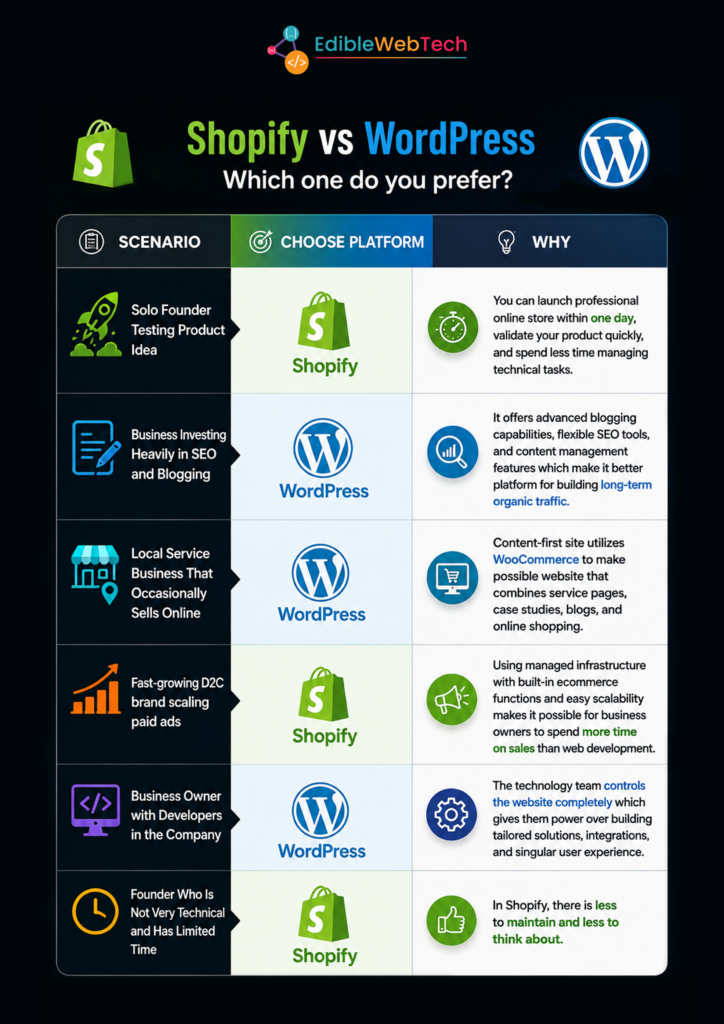
In fight between Shopify vs WordPress, there is no single winner. The right platform depends on your business goals, technical skills, marketing strategy, and future plans. Here are some practical recommendations based on common scenarios.
| Scenario | Choose Platform | Why |
| Solo Founder Testing Product Idea | Shopify | You can launch professional online store within one day, validate your product quickly, and spend less time managing technical tasks. |
| Business Investing Heavily in SEO and Blogging | WordPress | It offers advanced blogging capabilities, flexible SEO tools, and content management features which make it better platform for building long-term organic traffic. |
| Local Service Business That Occasionally Sells Online | WordPress | Content-first site utilizes WooCommerce to make possible website that combines service pages, case studies, blogs, and online shopping. Fast growing D2C brand scaling paid ads |
| Fast-growing D2C brand scaling paid ads | Shopify | Using managed infrastructure with built-in ecommerce functions and easy scalability makes it possible for business owners to spend more time on sales than web development. |
| Business Owner with Developers in the Company | WordPress | The technology team controls the website completely which gives them power over building tailored solutions, integrations, and singular user experience. |
| Founder Who Is Not Very Technical and Has Limited Time | Shopify | In Shopify, there is less to maintain and less to think about. |
Final Verdict
There is no single winner here. It all depends on how you plan to run your business. If you plan to start selling fast without headache of hosting and maintenance then Shopify is perfect. If you are building business around content, SEO, and long-term organic growth then WordPress is worth it.
So,if you are still not sure which one is better for your business. Don’t worry, our team at EdibleWebTech works with both e-commerce platforms daily. We help you decide what actually makes sense for your business, your budget, and where you want to be year from now.
FAQs
Can I switch from Shopify to WordPress later?
Yes. You can switch from Shopify to WordPress at any stage of your business. With migration tools and professional services, you can migrate your products and customer information. But you required careful planning is important to preserve SEO rankings, redirects, and website performance during the migration.
Is WordPress really free?
Yes. WordPress is free CMS platform. You just need to buy domain name, hosting plan, premium plugins and website theme depending on your business needs. Overall cost will still be lower than Shopify.
Does Shopify support blogging?
Yes. Shopify has in-built feature of blogging. It allows businesses to publish articles, announcements and basic SEO content. But WordPress provide advance blogging system with better content organization and SEO capabilities for businesses focused on organic growth.
Which e-commerce platform has greater SEO capability in 2026?
When it comes to SEO, WordPress is great platform because it allows you to take advantage of long-term content marketing strategies. The good thing about it is that it gives you more control over your website’s structure, internal linking, schema markup, and more complex optimizations. Shopify has great SEO capabilities as well so it can be good option if the focus is primarily on products.
Is Shopify or WordPress better for Indian small businesses?
Selecting the right option between Shopify and WordPress requires knowing your business objectives and technical background. Shopify is preferable if you want easy-to-use e-commerce platform without many maintenance issues. If you are more interested in long-term cost effectiveness, customization opportunities, and improved content marketing functions then your option should be WooCommerce.
