
If you are reading this article, maybe you are also stuck on how to rank website on Google first page?
75% of users never scroll past first page of Google results. That means if you are not showing on Google first page, you are losing your potential traffic. This guide shows you exactly how to rank website on Google’s first page. It covers keyword research, on-page SEO, technical fixes, content strategy, backlinks, local SEO, and how to track your progress. We guide you on every tactic here that is based on what actually works in 2026. No shortcuts. No black hat SEO tricks.
How To Rank Website on Google First Page: Complete Guide
What Google Actually Looks for Before Ranking Website?
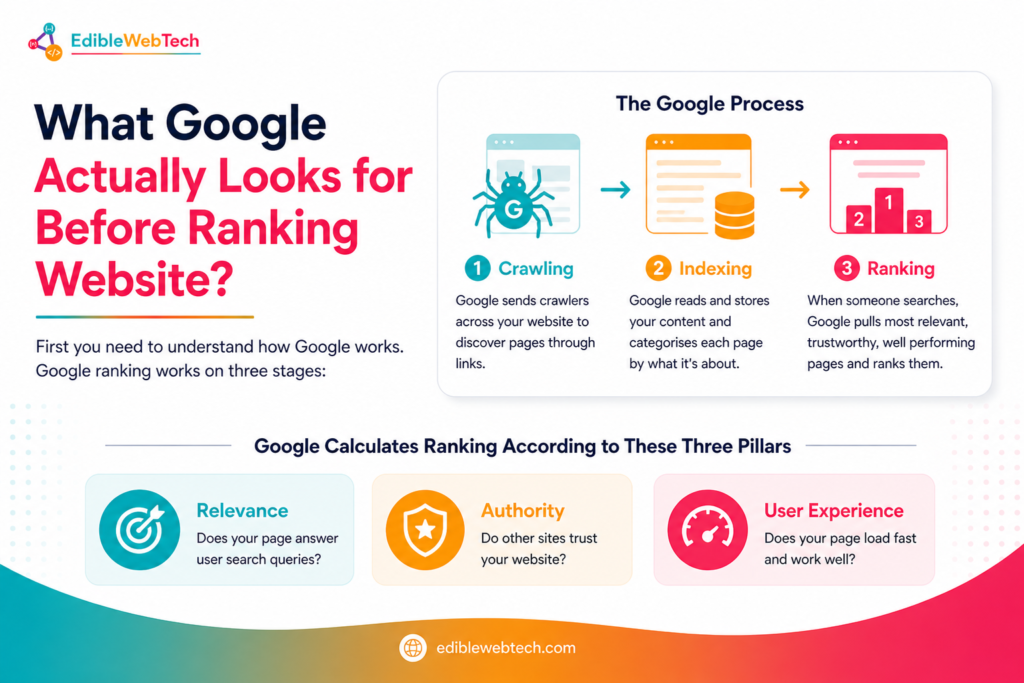
First you need to understand how Google works. Google ranking factors work on three stages:
- Crawling: Google sends crawlers across your website to discover pages through links.
- Indexing: Google reads and stores your content and categorises each page by what it’s about.
- Ranking: When someone searches, Google pulls most relevant, trustworthy, well performing pages and ranks them.
Google calculates ranking according to these three pillars:
- Relevance: Does your page answer user search queries?
- Authority: Do other sites trust your website?
- User Experience: Does your page load fast and work well?
Most of the websites do not rank because they have not worked on them according to Google’s content ranking algorithm. They publish thin content, skip technical SEO, and build no backlinks at all.
Google updates its algorithm frequently. Updates like Helpful Content Update have pushed one clear message: write for real people, not search engines. Pages that exist purely to chase rankings but offer nothing useful get buried.
Find the Right Keywords Before You Write Single Word
Keyword research is where SEO starts. If your keyword research is not strong then all your other efforts are wasted. Search your keywords according to their intent. It means every search has intent behind it. There are four types of keyword search intent:
| Keyword Intent | Description | Example |
| Informational | person who wants to learn. | What is SEO |
| Commercial | person is comparing options | Best running shoes |
| Navigational | person wants specific site | Best cafe near me |
| Transactional | person is ready to act | Hire SEO agency |
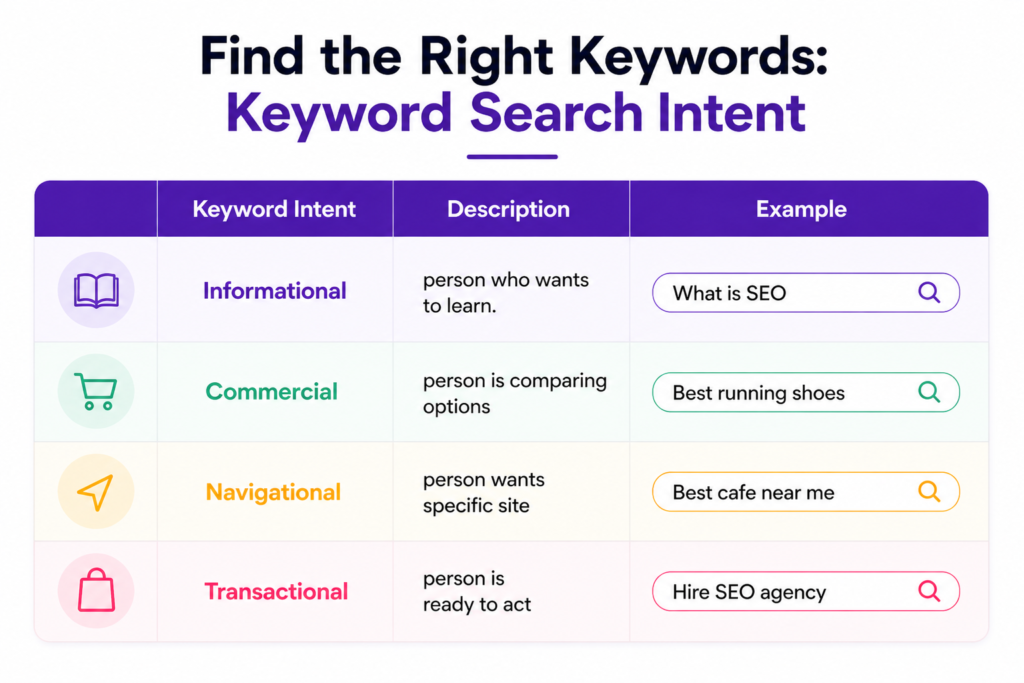
Intent plays very important role because your strategy works on keywords. For example: There is two keywords, one is ‘best SEO services’ and other is ‘hire SEO agency.’ The first is commercial intent so you need comparison style page with reviews and credentials. The second is transactional so you need direct service page with clear call to action. Same topic but different approach.
Tools To Find Your Keywords
- Start with Google Search Console if your site is already live. It shows you what searches are already bringing impressions to your pages. It is free and gives you real data.
- To check search volume and keyword difficulty of keywords, you can use keyword research tools such as Ubersuggest, Ahrefs, and Semrush. These tools show how many people search for keyword each month and how difficult it is to rank for.
- Do not overlook free research. Google’s ‘People Also Ask’ boxes and autocomplete suggestions are genuine demand signals. Whatever Google autocompletes is something people actually type.
How to select keywords that help to rank fast?
If your site is new, dont pick competitive terms like SEO and digital marketing. You can use long tail keywords like best digital marketing agency in Amritsar which have good search volume and low keyword difficulty. This improves your chances of ranking faster and helps increase website visibility organically.
On-Page SEO: Optimize Every Page Before Google Can Rank It
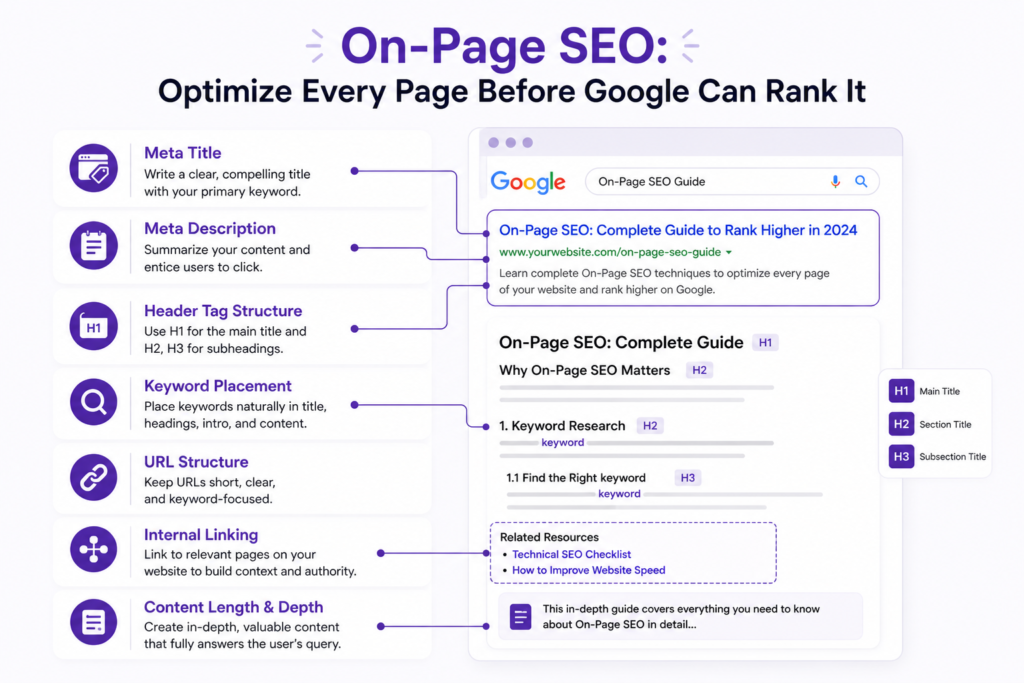
On page SEO means everything you control directly on the page. When you optimize on page SEO its helps to rank your website on Google first page. In on page optimization, you need to work on:
- Meta title and Meta description
- Header tag structure
- Keyword Placement
- URL Structure
- Internal Linking
- Content length and depth
Meta Title Tags and Meta Description
To optimize your meta title tag, it should be under 60 characters with your primary keyword. Lets understand with example:
Weak title: SEO tips for beginners
Strong title: How to rank website on Google first page: Complete guide
Your meta description should be 150 to 160 characters and include clear reason to click. Do not just describe the page, give the reader a reason to choose your result over the others.
Header Tag Structure
- Header tag structure includes H1, H2, and H3. Use only one H1 per page. That’s your main topic statement.
- H2s should target secondary keywords like “search engine optimization techniques”.
- H3s break up longer sections and appear as featured snippet answers.
Keyword Placement
Keyword optimization is important for on-page SEO because it helps search engines understand the content and context of webpage. IT also makes it easier to match that page with relevant search queries.
Make sure your target keyword is placed in H1, first 100 words, one H2, URL slug, image alt text and meta title. Do not stuff your target keyword everywhere. Your keyword density should be 1–1.5%. Place keywords strategically in your content so that users as well as search engines understand what content topic is about. This helps your content to rank on search engine results pages.
Internal Linking
In on page SEO, internal linking is underrated powerful SEO strategy. It improves crawlability, distributes link equity, and boosts topical authority.
- Use descriptive and keyword rich anchor text for internal linking. For example: instead of ‘click here’, you can use ‘digital marketing for beginners’.
- Check your top performing pages from Google Search Console and make sure these pages both receive and give internal links.
- Use proper navigational links for hierarchy.
- Detect orphan pages from your site and remove them.
- Regularly check broken links in your website and fix them.
Content Depth and Length
According to HubSpot, pages ranking on Google’s first page average over 1400 words. But only content length does not rank your website on Google first page. You also need to add depth in your content. Long form content gets 3x organic traffic that short form content because it fully satisfies user search.
Technical SEO: Improve Your Technical SEO To Rank on SERP
If your content is solid, on page SEO is perfect but your website is technically unfit then your website will face issues ranking on first page of Google. Small technical fixes will impact big to rank your website. Here are some technical SEO checklists that you need to improve on your website.
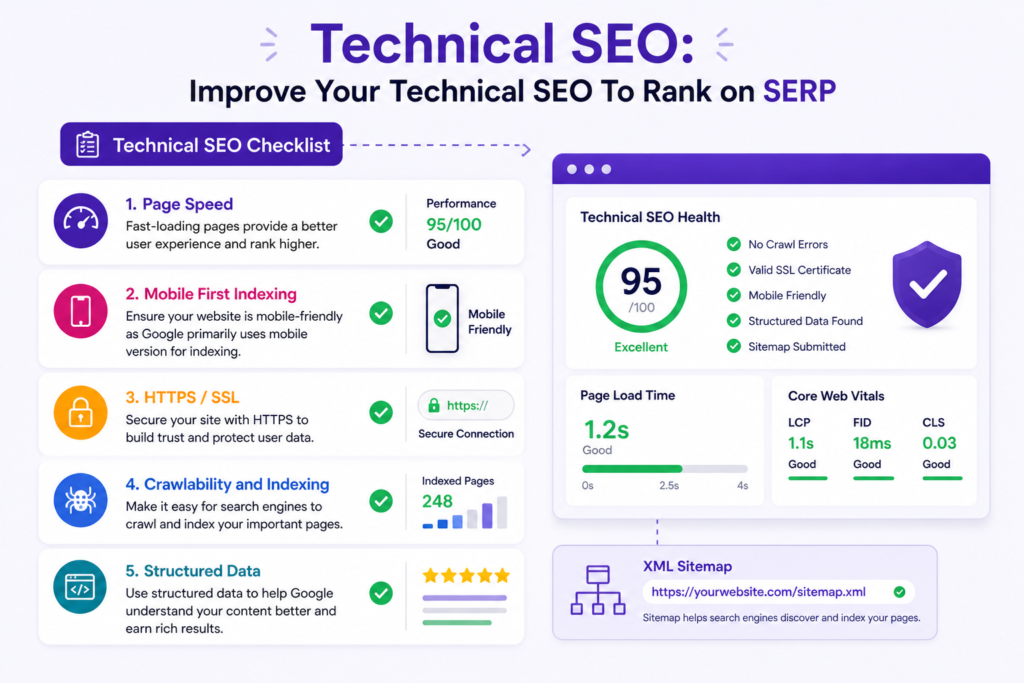
- Page Speed
- Mobile First Indexing
- HTTPS / SSL
- Crawlability and Indexing
- Structured Data
Page Speed
If your website is slow, you lose your customers and it increases your bounce rate on your website. Google monitors your website page speed insights, if your its low then Google lowers your rank. Google uses Core Web Vitals as direct ranking signal. So focus on Largest Contentful Paint (LCP): it should load in under 2.5 seconds.
- Compress images before uploading
- Enable browser caching
- Use Content Delivery Network
You can use Google PageSpeed Insights and GTmetrix to check your page speed metrics. Page speed optimization is one of the most direct ways to improve search engine ranking.
Mobile First Indexing
As you know mobile phones are main devices for user search. Your website should be responsive website because if Google feels your website does not properly appear on mobile devices, they lower your rank on search engine.
HTTPS / SSL
Google marks HTTP sites as ‘not secure website’ in browser. That warning kills trust and hurts your rankings. Most hosting providers include free SSL certificate. There is no excuse to run without one.
Crawlability and Indexing
- Submit your XML sitemap to Google Search Console so Google knows what pages to crawl.
- Check your robots.txt file to make sure it is not accidentally blocking your important pages of your website.
- Fix 404 errors because they waste your crawl budget and frustrate users.
Structured Data
Schema markup tells Google what your content means. Use FAQ schema, article schema, and local business schema where applicable. This is what generates rich results like star ratings and FAQs in Google’s search results. You can use Google’s free Rich Results Test to validate your markup.
Content That Ranks: Write Helpful and High quality E-E-A-T Content
You have heard many times that content is king. Whether it is traditional SEO or SEO in 2026, content always rules. If your website has thin and irrelevant content, your website will never rank on search engines. Your content strategy determines your long term search engine optimization success. Google has now become more smart and advance, now they not only check keywords in your content.
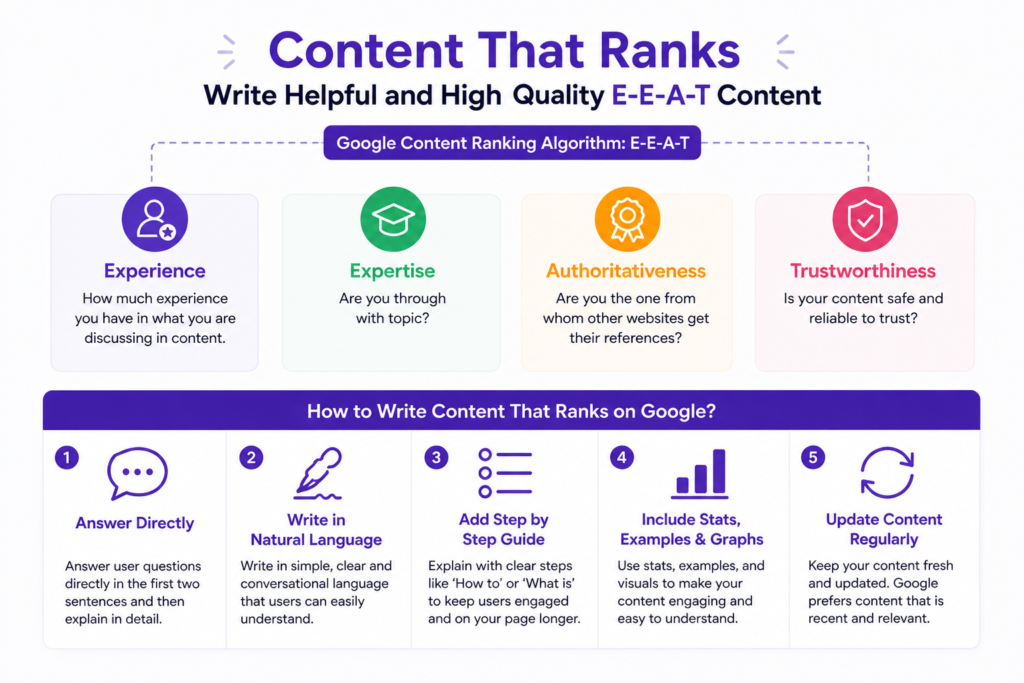
Google content ranking algorithms follow E-E-A-T, which means:
| Experience: how much experience you have in what you are discussing in content. Expertise: Are you through with topic? Authoritativeness: Are you the one from whom other websites get their references? Trustworthiness: Is your content safe and reliable to trust? |
When your content aligns with E-E-A-T principle, Google places your page at top of search results when user searches for it.
How to write content that ranks on Google?
Here is content writing formula that helps you to rank your content at top of search engine results.
- Directly Answer User Questions: To appear in rich snippet results, try to answer directly in first two sentences and then explain concept deeply.
- Write in Natural Language: Users want simple and clear answers. So write content as you converse with your friend.
- Add Step by Step Guide: If you properly explain content like ‘How to’, ‘What is’, your user stays longer on website and this indicates to Google that your website content is helpful.
- Include Stats, Examples and Graphs: Make your content full of engagement. You can use images, stats, example in your content. If you write lengthy content without using these, no one will read your content. It feels lengthy and frictiony.
- Update Old Content Regularly: Google likes updated and fresh content so update your content regularly.
Create High Quality Backlinks To Build Trust
Another one of the most powerful ranking signals is high quality backlinks if you want to rank your site on top of search engines. Backlinks are like trust signals to your website. When someone refers to your website it tells Google that you provide relevant content. But Google likes quality backlinks not quantity.
What types of backlinks can you create that Google likes?
| Guest Posting | Add article on another website within your niche with link back to your site. |
| Skyscraper Technique | Find top ranking content on topic, make something better and then reach out to sites linking to original and offer yours as superior alternative. |
| Digital PR | Digital PR through original data studies and surveys attracts natural links. |
| Broken link building | Find dead links on relevant sites and offer your content as replacement. |
Local SEO: Rank Your Website in Local Searches
Another best way to improve search engine ranking is to create strong local presence. If you service specific area then local SEO is mandatory. Claim and fully complete your Google Business Profile. Businesses with complete profiles rank significantly higher in local results.
- Make sure your Name, Address, and Phone number (NAP) match exactly across every online directory.
- Collect genuine Google reviews and respond to all of them.
- Use local keywords in your content such as ‘SEO agency in Amritsar’ for local intent.
- Get listed on Indian business directories such as Justdial, Sulekha, and IndiaMart to build local citation authority.
Track and Measure Your SEO Performance
Without tracking results your SEO is guesswork and its never worked on. Use these SEO tools and KPIs to track:
| Google Search Console | Check clicks, impressions, average position, and Core Web Vitals. It is free and tells you exactly how Google sees your site. |
| Google Analytics 4 | It tracks organic traffic, bounce rate, and goal conversions. This is where you connect SEO work to business results. |
| SEMrush/Ahref | It tracks keyword rankings, your backlink profile, and competitor gaps. If your competitor is ranking for keywords and you are not targeting them, you will see it here. |
Ready To Rank Your Website on Google First Page?
Now you have full complete SEO blueprint include keyword research, on page SEO, technical SEO, content strategy, backlinks, local SEO, and clear way to track your results. SEO takes times to show results. If you implement these search engine optimization techniques in right way, you will see improvements in your SEO performance.
If you want help in how to increase website traffic organically, our team at Edible WebTech offers you free SEO audit to show you exactly where your site stands and what to fix first.
